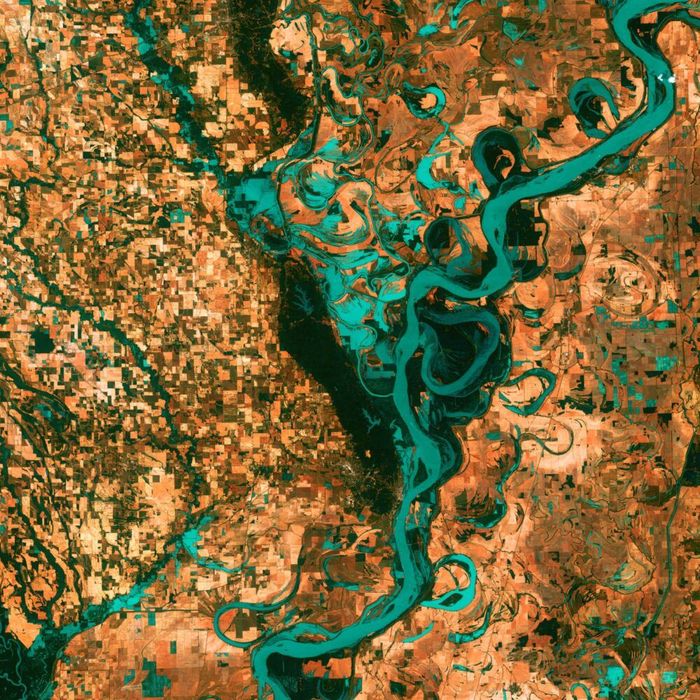
Satellites can provide a wide range of water quality measures such as temperature, light attenuation, oil slicks, organic matter, chlorophyll, turbidity, and benthic habitat type. Research and practical applications have evolved and quickly improved with newer satellite technologies including operational missions such as the European Sentinels, 2-5m resolution commercial missions, and new/upcoming hyperspectral missions, such as the NASA PACE and GLIMR missions.
Across the US, there are field measurements of water temperature for more than 11,000 lakes (data available in the Water Quality Portal). The Landsat (30m spatial resolution) satellite substantially increases the number of lakes to more than 170,000 lakes across the US. That number doesn’t even include measurements from rivers and estuaries! By the way, Landsat surface temperature data is freely available at the USGS Earth Explorer website.
A recent study on potential annual cost savings looked at the satellite monitoring of chlorophyll from the European Space Agency Sentinel-3 and NASA and USGS Landsat satellites was between $5.7-$316 million just for lakes! Also, satellite data used in recreational early warning systems have been shown to save $360,000 in a single advisory case study. That is huge! Satellites span political and geographic boundaries, provide an opportunity for systematic approaches to better target discrete sampling, and a more comprehensive spatial and temporal context. Within this scenario, IWA can help to widen the use of these products in the water industry and ensure they are universal and accessible.
You may be wondering where we are in terms of satellites technology adoption. Operational satellites such as Landsat, the European Sentinels, and even commercial satellites allow for long term investments and benefits that can cover the full technology adoption lifecycle. Based on a technology adoption lifecycle, the water satellite community is currently in the “early adopters” phase and transitioning to the “early majority.” Satellite derived water quality information is now at the phase where there are some early adopters of the technology and progress is accelerating quickly.
Additional evidence of the early majority adoption of satellite technologies comes from American Water Works Association’s (AWWA) update of the M57 manual on algal source to treatment methods. The manual is being updated with a new chapter dedicated to the use of satellite remote sensing techniques. Also, the Interstate Technology Regulatory Council (ITRC) has included satellite remote sensing as a monitoring tool in their guidance. Finally, the World Health Organization (WHO) has also included remote sensing as a monitoring tool in their recently updated guide for cyanobacteria.
There is strong evidence that the use of satellites for water quality is transitioning from the early adopters to the early majority, including supporting efforts to meet the United Nations’ SDGs. The satellite water quality community has been looking at how satellites can provide essential metrics for the achievement of SDG 14 on coastal eutrophication and SDG 6 on freshwater ecosystems, using metrics of chlorophyll and turbidity. This clearly aligns with IWA’s mission for a water wise world, which is linked to many SDGs, notably SDG 6.